
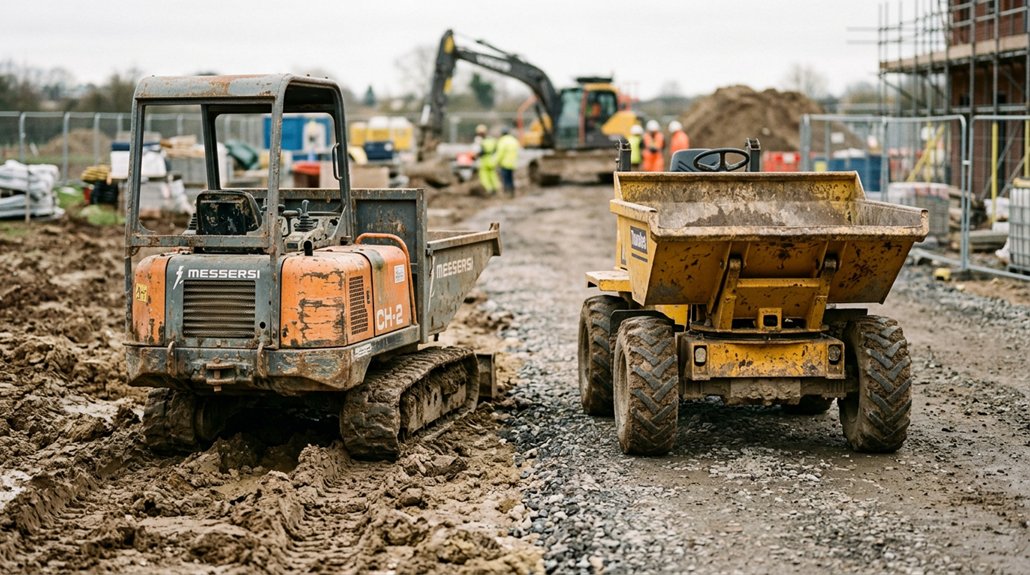
Choose a tracked dumper if your project involves soft, muddy, steep, or uneven ground: its tracks spread the load, improve traction, and help limit ground pressure. Pick a wheeled dumper for firm, level, or paved routes, where you’ll benefit from faster travel and efficient turnaround. Before deciding, assess access, gradients, haul distance, payload, and surface conditions. Match the machine to the site, follow rated load limits, and factor in maintenance and operating costs. The key trade-offs become clearer when you compare each option.
Tracked vs. Wheeled Dumpers: What’s the Difference?
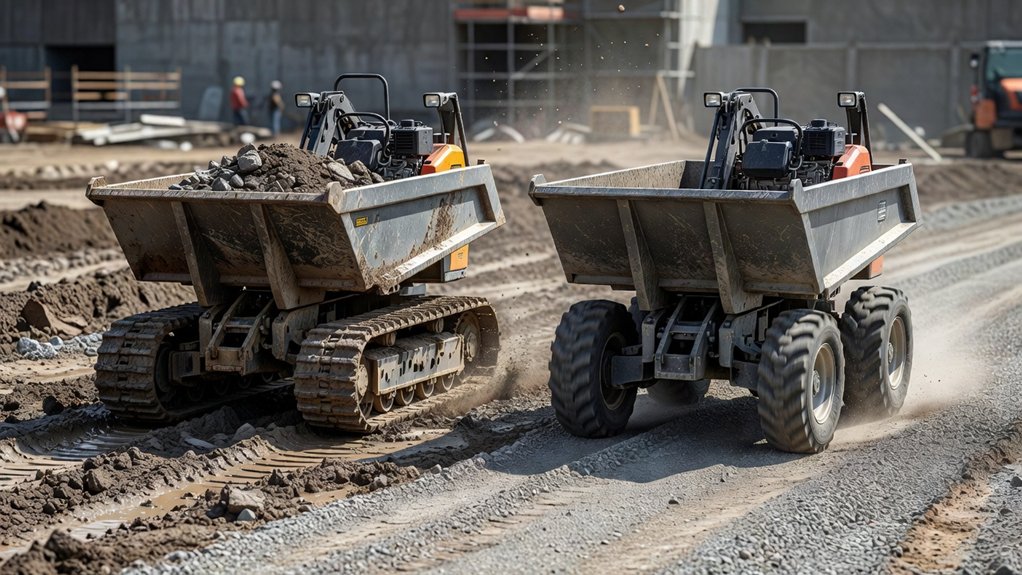
Tracked dumpers move on continuous rubber or steel tracks, while wheeled dumpers travel on tires.
Tracks spread machine weight across a larger contact area, reducing ground pressure and helping you maintain traction on soft, muddy, or uneven surfaces. Tires create less rolling resistance on firm ground, so wheeled models generally travel faster and steer more easily between work areas.
This difference shapes each machine’s terrain adaptability. Tracks can limit surface damage and improve stability, but they move slowly and may mark finished surfaces. Tires suit hard, level routes, though they can lose grip or sink in loose material.
Consider maintenance requirements too: tracks need inspection for wear, tension, and debris, while tires require pressure checks and damage monitoring. Both systems need regular cleaning and servicing to preserve safe operation and reliable performance throughout demanding site work.
Which Dumper Fits Your Site and Work?
Choosing between tracks and tires depends on your site conditions, haul routes, and the material you need to move. Start by evaluating ground firmness, gradients, turning space, and travel distance.
Then match the dumper’s payload and body configuration to your load, discharge point, and cycle time.
For repeated trips over firm, prepared routes, a wheeled dumper can offer efficient travel and straightforward maneuvering. If your work spans changing surfaces or confined areas, compare each machine’s dimensions, ground pressure, and stability against the route.
Check access constraints, loading equipment, and whether you’ll need to transport the dumper between sites.
Include Maintenance considerations in your cost comparison: tires, tracks, service intervals, and parts availability affect uptime.
Consider Environmental impact, too; route damage, fuel use, and noise can influence site controls and operating costs.
Choose against measured needs, not assumptions.
When Are Tracked Dumpers the Better Choice?
When soft ground, steep gradients, or tight access make wheeled travel unreliable, a tracked dumper can provide better traction and lower ground pressure. Choose tracks when you need to cross mud, loose soil, sand, or uneven ground without sinking or damaging the surface. Their broad contact area helps you maintain stability on slopes, while compact models can maneuver through restricted routes and around obstacles.
Assess the machine’s rated payload and slope limits against your site conditions; tracks improve access but don’t remove operating limits. Consider terrain adaptability alongside travel distance and cycle time, since slower travel can affect productivity over long hauls.
Before you commit, check maintenance requirements: undercarriage wear, track tension, and debris buildup need regular inspection. A tracked dumper suits projects where grip, flotation, and controlled movement matter most.
When Are Wheeled Dumpers the Better Choice?

On firm, relatively level ground, a wheeled dumper often moves materials faster and more efficiently than a tracked model. Choose one when your site has compacted soil, paved access routes, or established haul paths. Its tires roll smoothly across these surfaces, helping you complete repeated trips without the slower travel typical of tracks.
Wheeled machines also suit projects where you need to move between work areas or travel on roads, provided the dumper meets local requirements.
Consider Terrain adaptability before choosing: loose, steep, or muddy ground can reduce tire grip and limit access. On stable surfaces, however, wheels offer practical maneuverability and responsive steering.
Review Maintenance requirements too. Tires need routine pressure checks and inspection for cuts or wear, while the simpler running gear can make upkeep straightforward for your crew.
How Do Safety, Payload, and Cost Compare?
Although tracks can improve stability and reduce ground pressure on soft terrain, neither dumper type is inherently safer; safe operation depends on matching the machine to the site, load, and operator. Check gradients, turning space, visibility, and ground conditions before choosing.
Keep within the rated payload, account for material density, and distribute loads evenly; overloading raises rollover risk and accelerates wear. Wheeled dumpers often carry more and travel faster on firm ground, while tracked models maintain traction on mud and slopes.
Compare purchase price, fuel use, transport needs, and maintenance requirements over the machine’s full service life. Tracks can cost more to replace, while tires may wear quickly on abrasive surfaces.
Consider Environmental impact too: ground disturbance, emissions, and route length affect your project’s footprint. Choose the configuration that meets site demands without excess capacity.
Leave a Reply