
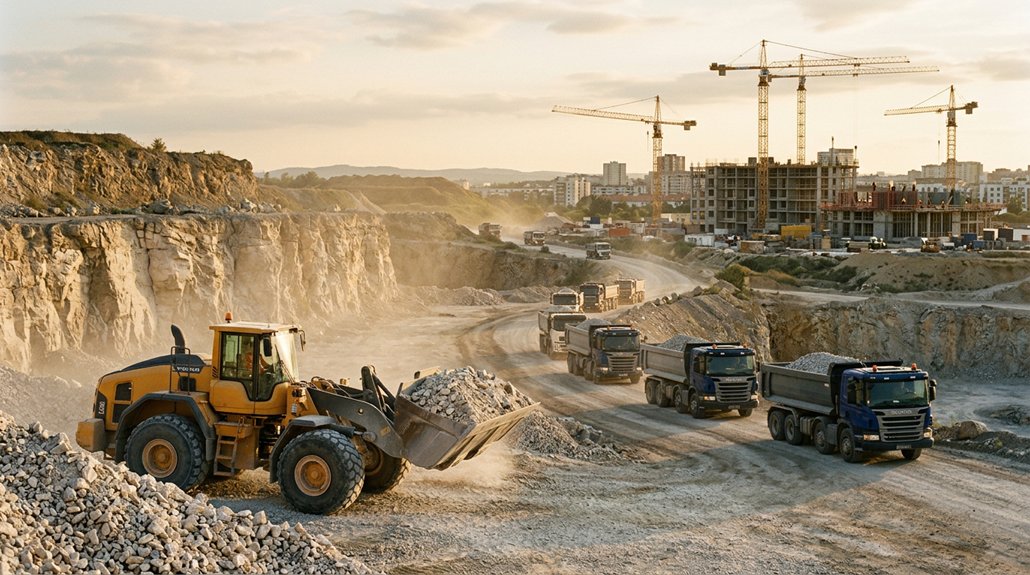
You can trace aggregate from controlled quarry extraction to the construction site. Crews drill and blast rock, or use mechanical cutting where conditions restrict blasting. Loaders and excavators feed haul trucks, which deliver material to primary and secondary crushers. Screening decks separate crushed rock into specified sizes. Operators monitor equipment, gradation, and safety throughout production. Trucks, railcars, or barges then carry graded aggregate to project sites. The next sections explain each stage and the equipment that keeps material moving.
How Is Rock Extracted From the Quarry?
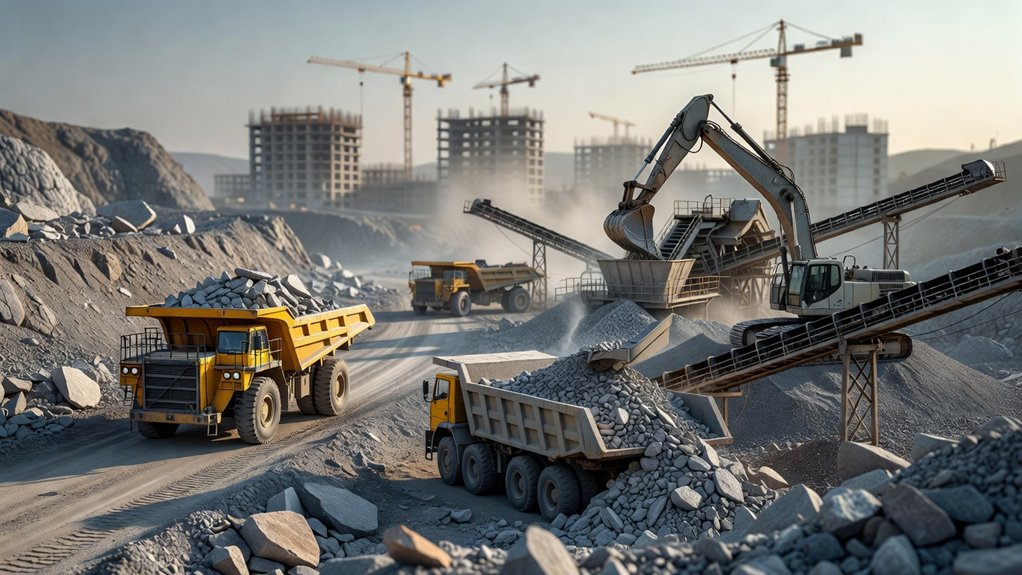
Quarry operators extract rock by drilling, blasting, or mechanically cutting the deposit, depending on its geology and intended use. You’ll see the method selected through geological surveys, production requirements, and site constraints.
Drilling creates controlled holes for explosives; blasting fractures the rock into manageable sections. Where geology or nearby infrastructure limits blasting, operators may use mechanical cutting or hydraulic breakers.
Before work begins, crews assess ground stability, mark exclusion zones, and verify equipment condition. Strong quarry safety procedures govern blast design, firing, and post-blast inspections.
You’ll also find operators monitoring vibration, dust, noise, and water quality to control environmental impact and meet permit conditions. Extraction plans define bench heights, face angles, and sequencing, helping you maintain stable working surfaces and recover usable material while limiting hazards and disturbance across the site.
How Does Rock Reach the Crusher?
Once crews break the rock, loaders or excavators move it to haul trucks, which carry it along designated quarry roads to the crusher’s feed hopper. This Rock transportation system depends on matching truck capacity to loader output and maintaining steady, controlled deliveries.
You’ll find that road width, grade, surface condition, and turning radius affect cycle time and equipment wear. Operators follow traffic plans, observe speed limits, and keep safe distances, especially near loading zones and blind corners.
Quarry safety also requires clear radio communication, functioning lights and alarms, and regular equipment inspections. Dispatchers coordinate truck movements to prevent congestion and reduce idle time.
At the hopper, drivers position vehicles on stable ground and discharge loads under the spotter’s direction. These controls keep material moving reliably to the crusher.
How Does Aggregate Processing Size Material?
At the crusher feed hopper, aggregate processing begins by reducing and sorting rock into controlled size ranges. You direct material through primary and secondary crushers, selecting jaw, cone, or impact units to match feed characteristics and product specifications.
Each stage applies controlled force to fracture oversized rock while limiting unwanted fines. Adjustments to crusher settings, rotor speed, and feed rate help you maintain target gradation and throughput.
Processing equipment must withstand abrasive loads, impact, and continuous operation, so you’ll monitor wear parts and lubrication to protect performance. Material hardness, moisture, and shape also affect crushing efficiency.
How Do Screens Sort Aggregate by Size?
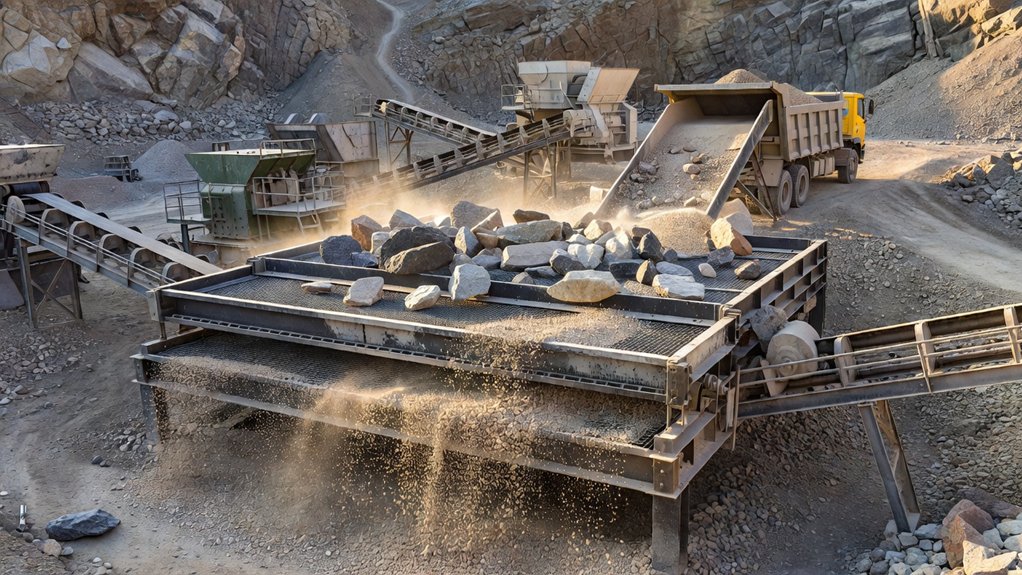
Screens separate crushed aggregate into size fractions by passing it across vibrating decks fitted with openings of specified dimensions. As material moves across each deck, particles smaller than the apertures pass through, while larger pieces continue toward the discharge end. You can configure multiple decks in a stack, using progressively smaller openings to produce several product sizes in one operation.
Your screen’s motion, deck angle, feed rate, and aperture condition all affect Screen efficiency. Excessive feed depth can prevent particles from reaching the openings; worn or blinded media can reduce separation accuracy.
You should match screen settings to the required Aggregate grading and inspect the decks regularly. Consistent screening gives you controlled fractions for downstream processing and helps maintain product specifications.
Monitor throughput and material samples to identify changes in separation performance promptly.
How Is Aggregate Delivered to Construction Sites?
After screening, producers load each aggregate grade into trucks, railcars, or barges for transport to construction sites. Your delivery method depends on distance, volume, access, and schedule. Trucks offer flexible, direct delivery, while rail and barges move large tonnages efficiently over longer routes.
Effective Transportation logistics coordinate carrier availability, loading capacity, permits, route restrictions, and site receiving hours. You’ll need clear delivery tickets identifying material type, gradation, quantity, and source so crews can verify each load.
At the site, drivers follow designated routes and discharge into assigned stockpiles or hoppers, reducing contamination and equipment conflicts. Plan unloading space and traffic control before arrival.
To limit Environmental impact, consolidate loads, optimize routes, maintain vehicles, and prevent spillage or dust. These controls help you protect nearby communities and keep aggregate supply aligned with construction demand.
Leave a Reply