

To choose an excavator for large-scale groundworks, first quantify excavation volumes, depths, access needs, and cut-and-fill requirements. Match the machine’s reach, digging depth, and load-chart capacity to your plans, then select tracks suited to soil firmness and slopes. Choose compatible attachments for each material and task. Check utilities, ground bearing, transport access, operator credentials, and hire costs, including delivery and fuel. Set safety limits and measurable completion criteria; the key selection checks are outlined below.
Define Your Groundworks Project Requirements
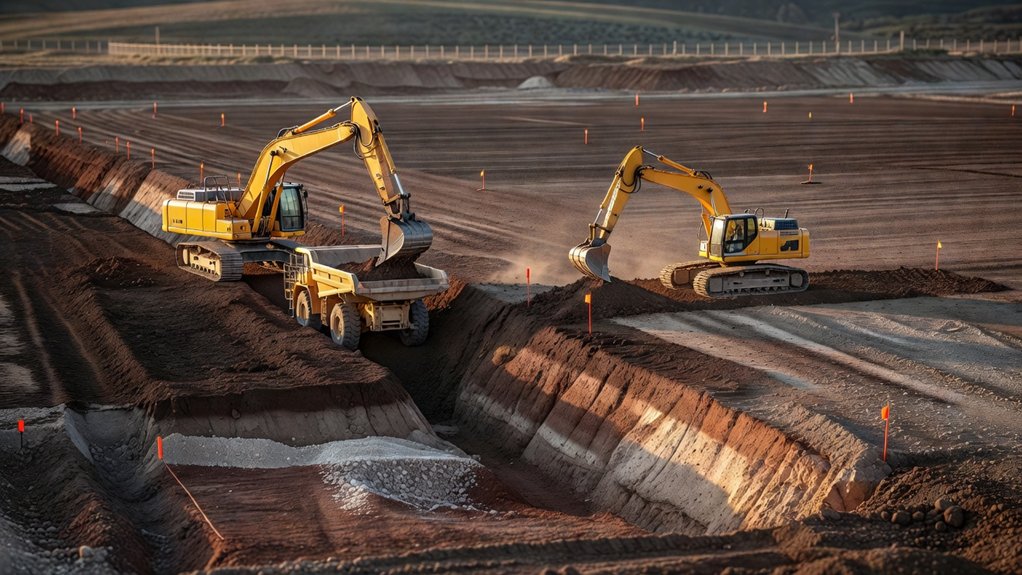
Before comparing excavators, define the scope and constraints of your groundworks project. Quantify the area, excavation depth, material volumes, and required cut-and-fill balance.
Specify whether you’ll handle grading, trenching, foundation excavation, drainage, or bulk earthmoving, and identify how these tasks connect.
Document access limits, working hours, utility locations, ground protection requirements, and disposal arrangements. These details establish realistic production targets and help you plan site preparation without disrupting other trades.
Set measurable acceptance criteria, including finished levels, tolerances, compaction standards, and inspection points.
Then map task dependencies, delivery dates, weather allowances, and contingency time into a project timeline.
Confirm available labor, transport, fuel, and support equipment, plus any budget or environmental limits.
A clear requirements brief lets you compare machine options against actual workload, capacity, and schedule demands.
Choose an Excavator for Your Site Conditions
With your project requirements defined, match the excavator to the site’s ground, access, and operating constraints. Assess soil stability before selecting an undercarriage. Firm, compacted ground can support standard tracks, while soft, saturated, or uneven terrain may require wider tracks or low-ground-pressure equipment to reduce sinking and maintain traction.
On slopes, choose a configuration suited to the grade, and establish safe operating limits before work begins.
Check access routes, turning space, overhead clearance, and ground-bearing capacity along the entire travel path. If you’re working near utilities, structures, or sensitive habitats, account for vibration, noise, and environmental impact when choosing machine size and operating method.
Consider weather and seasonal changes, too: rain can weaken soil, and freeze-thaw cycles can alter traction. Verify site conditions with current surveys, then reassess after significant changes.
Compare Excavator Reach, Depth, and Lift Capacity
Compare the excavator’s working range with the farthest dig, deepest cut, and highest lift your project requires. Check the manufacturer’s reach and digging-depth specifications against your site plans, allowing clearance for slopes, utilities, and stable positioning.
For lifting, use the load chart for the machine’s exact configuration, including boom position, track width, and counterweight. Capacity falls as working radius increases, so verify the load at the required reach—not just the machine’s maximum rating.
Keep loads within chart limits and account for ground conditions, especially near trenches or edges.
Excavator mobility affects where you can position the machine to meet these limits; assess access and repositioning needs before selection.
Confirm operators have suitable operator training to read load charts, maintain safe clearances, and recognize when reach or lift limits require a different machine.
Match Attachments to Your Groundworks Tasks

Choose attachments around the materials and tasks your excavator will handle, not just the machine’s size. Match bucket width, shape, and capacity to soil conditions, trench dimensions, and production targets. Use a narrow trenching bucket for precise cuts, a wider bucket for bulk excavation, and a grading bucket for shaping slopes or finishing surfaces.
For rock, demolition, or compacted ground, select a breaker or ripper rated for the excavator’s hydraulic flow and pressure. Check coupler compatibility, attachment weight, and required auxiliary lines before you commit.
Attachment versatility can reduce changeover time across varied work, but only when each tool suits the machine and task. Confirm your operator training covers safe coupling, control settings, and attachment-specific operating limits.
Review the planned sequence so you can choose a practical attachment set without overloading the excavator.
Check Access, Safety, and Excavator Hire Costs
Before booking, confirm the excavator can reach the site and operate safely within its constraints. Check access roads, gate widths, overhead cables, ground bearing capacity, and turning space against the machine’s transport dimensions and operating radius.
Arrange suitable low-loader delivery and identify any permits or traffic controls required. Assess underground services, slopes, exclusion zones, and emergency access before work starts.
Verify that your operator holds the required competency credentials and receives site-specific induction; operator training must cover the selected machine and attachments.
Plan site security to protect parked equipment, keys, and fuel, especially overnight.
Compare hire quotes by checking transport, fuel, insurance, attachments, cleaning, and damage charges. Confirm minimum hire periods, overtime rates, breakdown response, and replacement arrangements.
A clear cost schedule helps you budget accurately and avoid delays.
Leave a Reply